
Skip to main content ↓

AI for Sales: Complete Guide to AI Types, Tools, and Use Cases for Sales Teams

Abstract visualization of artificial intelligence connections representing sales technology integration

As of October 2024, the Power AI plan has been renamed to Business. Learn more here.

You’re not alone if you’re wondering whether AI for sales is worth the investment—or if you’re already behind the curve.

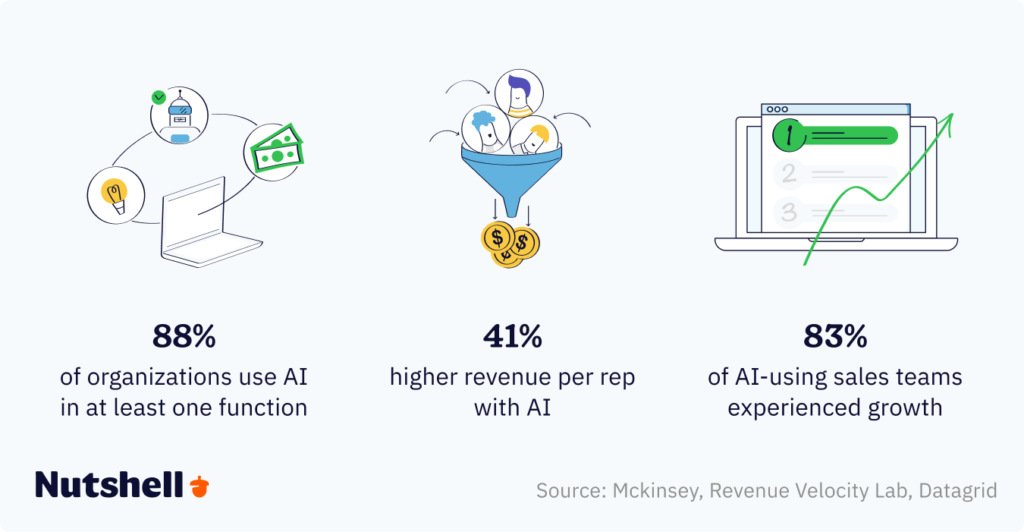
The pressure is real. As of 2025, 88% of organizations are using AI in at least one business function. In sales specifically, 81% of teams have either experimented with or fully implemented AI tools. The competitive gap is widening fast: sales teams using AI experienced 17 percentage points more growth than those without it in 2025.

But here’s what matters more than adoption rates—AI-augmented sales reps achieve 41% higher revenue per rep while performing 18% fewer activities, according to a 2025 benchmark study of 938 B2B companies. That’s $1.75 million versus $1.24 million per rep, with less busywork and more time for actual selling.

The question isn’t whether AI will transform sales. It already has. The real question is how you can adopt it strategically without overwhelming your team or wasting resources on tools that don’t fit your process.

This guide helps you see through the hype. We’ll show you what AI actually does in sales, which applications deliver real results, how to implement it without disrupting your workflow, and what challenges you need to plan for. 

Whether you’re a sales rep looking to work smarter, a manager evaluating tools, or a business owner concerned about ROI, you’ll find practical answers here.

Headshot

Supercharge your CRM with the power of AI!

Work smarter, not harder. Nutshell’s AI features summarize timelines and call or meeting transcriptions, take speech-to-text notes, help you craft emails, and generate insights so your team closes deals faster.


What is artificial intelligence?

Artificial intelligence (AI) is the ability of machines, especially computer systems, to perform tasks typically associated with human intelligence, such as learning independently, reasoning, and decision-making. AI systems can learn from experience and adjust their behaviors based on what they’ve learned, produce insights by analyzing data, make decisions based on data, and generate new media such as text, images, or sound.

Types and AI applications

There are many subsets of AI that use various approaches and have different applications. Sometimes, these terms are used interchangeably with AI, but specific differences exist. Here are a few of the most common branches of AI.

What is machine learning?

Machine learning is a subset of AI that enables computer systems to learn and improve on their own based on their experience rather than through direct instruction. This ability enables the system to become more accurate over time.

What is deep learning?

Deep learning is a subset of AI that uses artificial neural networks modeled after the human brain. These systems analyze unstructured data and learn to identify patterns and features in the data independently.

What is natural language processing (NLP)?

Natural language processing (NLP) is a branch of AI that focuses on enabling AI systems to understand and generate human language.

Automation vs. AI

Another term that is often confused with AI is automation. While researching tools, watch out for companies using the term AI when automation is really the more fitting term. 

Automation is using technology to perform tasks that humans would otherwise perform, reducing or eliminating the need for human labor to complete a task.

You can use AI for automation, but the terms don’t mean precisely the same thing. Automated systems are programmed to complete a specific task. While they can be highly beneficial, they don’t learn on their own, reason, or make decisions like AI systems do.

The competitive reality: Why AI adoption is accelerating in 2026

The AI adoption curve has hit an inflection point. What began as experimental technology for enterprise sales teams has become accessible to businesses of every size—and the results are compelling enough that waiting is becoming costly.

Early AI adopters report win rate improvements exceeding 30%. Additionally, 56% of sales professionals now use AI daily, and they’re twice as likely to exceed their targets compared to non-users.

And yet, almost 66% of organizations still don’t use AI at the enterprise level. Most teams remain stuck in the pilot phase, experimenting but not fully committing. This creates an opening: companies that move decisively to scale AI now can capture significant competitive advantage while others hesitate.

The technology itself has matured dramatically. Agentic AI—systems that can autonomously plan multi-step workflows, take action, and adapt based on results—is now a reality. The agentic AI market is projected to grow from 7.55 billion in 2025 to 199.05 billion by 2034. 

Once again, AI agents don’t wait around for instructions. They’re proactive systems that identify opportunities, execute tasks, and continuously learn from outcomes.

For small and medium-sized businesses, this shift should be a big deal. AI levels the playing field, giving lean teams capabilities that previously required large sales operations. You can now automate lead qualification, personalize outreach at scale, and leverage predictive analytics—all without expanding headcount.

You might have noticed that the biggest winners in 2026 were early adopters who embraced AI and added it to their actual workflows. In other words, the window to gain first-mover advantage and differentiate your business is narrowing by the day.

Using AI in sales

As AI tools become more widely available and AI technology continues progressing, artificial intelligence significantly impacts many fields, including sales.

AI won’t completely replace salespeople any time soon. Sales is a people-focused field requiring advanced communication skills for building relationships—things AI can’t replicate.

However, using AI for sales and marketing can enhance various aspects of the role, such as providing insights based on data, identifying new leads, personalizing customer experiences, and optimizing sales processes to improve efficiency, accuracy, and productivity.

Graphic with a list of applications of how sales teams can use AI for sales

We discuss some of the applications of AI that are relevant to sales.

Chatbots

Chatbots provide instant responses to leads and customers, helping to qualify leads and move them through the sales process. These tools can answer customer questions, gather lead and customer data, and recommend products.

Basic chatbots provide certain pre-programmed responses, while more advanced ones use AI to understand user input, generate responses, and improve responses over time.

Predictive analytics

Sales teams use AI-powered predictive analytics to evaluate data and make predictions. Uses of predictive analytics for sales include sales forecasting and lead scoring.

Sentiment analysis

AI, specifically NLP, can analyze customer interactions via chat, email, phone, and other channels and provide insights into how the prospect felt during the interaction.

These sales AI tools analyze interactions and typically label sentiment as positive, negative, or neutral. Using these insights, you can evaluate which sales techniques perform best and how customers feel about various products and services.

Segmentation and targeting

Using AI in sales and marketing also assists with segmenting leads and customers based on various characteristics to improve targeting and personalization. AI tools can quickly analyze large data sets and uncover patterns to strengthen outreach and target sales tactics based on the audience you’re reaching out to.

Lead generation

AI boosts sales prospecting and lead generation across various channels by improving targeting, personalization, decision-making, and more. Using artificial intelligence in sales and marketing can help teams quickly generate quality leads.

Text generation

Generative AI tools assist salespeople with producing text for emails, presentations, product guides, and other materials. These tools create outlines or first drafts of text or provide information to use in materials.

It’s important not to rely on generative AI entirely, though, as it can sometimes produce inaccurate information, and content generated solely by AI may not be ready for use with leads or customers.

Skip the blank template—generate email campaigns with AI

Go from prompt to polished first draft in minutes with the 1-click AI email campaign builder!

Sales automation

Sales automation tools, even those that don’t use AI, are a vital part of many sales teams’ strategies. Adding AI into your sales automation strategy can help make your team even more efficient.

AI sales automation tools can analyze large datasets and improve predictions and outputs as you use them. For example, AI sales automation tools could automatically send outreach emails and improve the targeting of those emails using AI.

Want to learn more about sales automation?

Watch our sales automation workshop for Nutshell users!

Watch the Workshop

a blue background with arrows and a green star

Price refinement

Some sales AI tools offer the ability to determine ideal pricing for a given customer. It does this using information gathered from past purchases and applies these to an algorithm to calculate and recommend the best pricing.

Attribution tracking

You can use AI for sales attribution tracking, giving you insight into what sales and marketing efforts are more successful. AI can also help you use this data to pinpoint customers most likely to garner a desirable ROI.

Performance monitoring

Monitoring your sales team’s performance and providing them with additional training when needed to remain successful can be costly and time-consuming. Now, sales managers can leverage the power of artificial intelligence to keep an eye on team members’ performance and equip them with additional knowledge.

Sales enablement

All these artificial intelligence and sales use cases translate to improved sales team enablement, providing them with the resources they need to enhance performance. From lead generation to segmentation, lead scoring and analytics, AI empowers your team, giving them insight that helps them to close deals, upsell, cross-sell, and more.

Benefits of AI for sales teams

How can using AI benefit your sales team? Here are some of the potential advantages it can provide.

Improved efficiency

Using AI in sales helps you to automate aspects of your sales process and provide your team with better information about leads, enhance sales techniques with personalization, and more. All of these applications increase efficiency.

More actionable information and insights

AI enables you to quickly analyze and pull insights from large data sets about your leads, customers, sales process, and more. You can use these insights to continually improve your sales processes and techniques.

More accurate predictions

AI helps you make more accurate predictions, such as with sales forecasting, which improves your planning and sets your team up for success. You can also better predict which leads will most likely become customers, helping you to focus your time and resources.

Reducing repetitive tasks

AI, and automation in general, reduces the amount of repetitive, non-selling tasks your team needs to do manually. This enables your team to focus on work that makes the best use of their skills and has the biggest impact, increasing productivity and job satisfaction.

Streamlined communication

AI in sales and marketing enhances collaboration both within teams and with customers. AI-powered sales tools help manage schedules, transcribe meetings, and summarize discussions. This ensures that everyone stays aligned and informed.

Real-world results: How Lenovo accelerated revenue with AI

The gap between AI hype and AI results often comes down to implementation. Here’s how one global company turned AI adoption into measurable revenue impact.

Lenovo faced a challenge familiar to many growing organizations. In 2025, they launched their Digital Workplace Solutions offering—a sophisticated suite requiring hundreds of geographically distributed sales reps to quickly master complex technical material. Traditional training methods were too slow. Sales cycles were stretching. Reps struggled to find accurate information during customer conversations, leading to delays and missed opportunities.

Rather than accept these limitations, Lenovo deployed an AI-powered revenue enablement platform that overhauled their workflows and processes: 

  • How their team trained
  • How they accessed information
  • How they engaged customers

The implementation included three core capabilities:

  • AI roleplay sessions allowed reps to practice customer conversations before actual meetings, receiving real-time feedback on messaging and handling objections. 
  • An AI agent provided instant answers to complex questions, eliminating the need to search through documentation or wait for subject matter experts. 
  • AI-powered sales rooms created dynamic, personalized spaces for deal pursuit, adapting content and recommendations based on each customer’s specific needs.

The results were immediate and substantial. In the first quarter alone, Lenovo’s team conducted over 2,000 AI roleplay and training sessions. The platform supported more than $400 million in total contract value through AI-enhanced sales rooms. 

Most dramatically, the time required to find accurate responses to client and internal questions dropped by over 90%.

What’s particularly instructive about Lenovo’s experience is how they approached implementation. They didn’t try to replace their sales team with AI. Instead, they used AI to remove friction, accelerate learning, and give reps superpowers they didn’t have before.

Sales professionals were still the ones building relationships and closing deals—AI just made them even more effective.

This pattern repeats across successful AI implementations. The technology augments human capabilities rather than attempting to replace them. Reps train faster, access information instantly, and spend more time on high-value activities that actually require human judgment and relationship skills.

For businesses evaluating AI, Lenovo’s approach offers a practical template: 

  1. Start with clear pain points—in their case, training speed and information access. 
  2. Choose AI tools that integrate into existing workflows rather than requiring entirely new processes. 
  3. Measure results that matter to revenue, not just efficiency metrics. 

Finally, focus on augmentation: using AI to make your team more capable rather than trying to eliminate human involvement.

Challenges and limitations of AI in sales

While using AI in sales can be extremely helpful for your sales team, it’s not a cure-all. There are certain challenges and limitations to keep in mind, including the following.

Balancing AI with human interaction

One challenge when implementing AI is balancing the use of AI with human interaction. If a sales team focuses too much on AI and neglects the human element in their process, they’ll be less effective, especially in areas like relationship building. You will also need to check the results of AI to ensure they’re accurate and fit into your sales strategy.

Potential inaccuracies

AI tools, especially generative AI, may sometimes provide answers, predictions, or insights that are inaccurate, inconsistent, or just don’t fit with the sales strategy you want to pursue. It’s crucial to review AI outputs for accuracy before using them. You can also increase accuracy by training AI tools on your company’s data and learning about best practices and tips for using the tools.

AI’s impact on job roles

A common worry is that AI will replace human employees. Because sales is such a human-focused field, AI isn’t going to replace salespeople, at least not any time soon. When used well, AI makes salespeople’s jobs more enjoyable and enables them to focus on the most rewarding parts of their job. However, this concern can sometimes cause resistance to adopting sales AI tools.

The cost of AI

Another challenge is cost. While AI is becoming more widely available, it still comes with significant expenses. Sales teams need to balance cost and the time and effort required to adopt new sales AI tools with the benefits those tools will provide.

Implementation roadmap: Your path to AI success

Want to start using AI to increase sales for your organization? Success comes down to strategic implementation, not just technology selection. Here’s your roadmap.

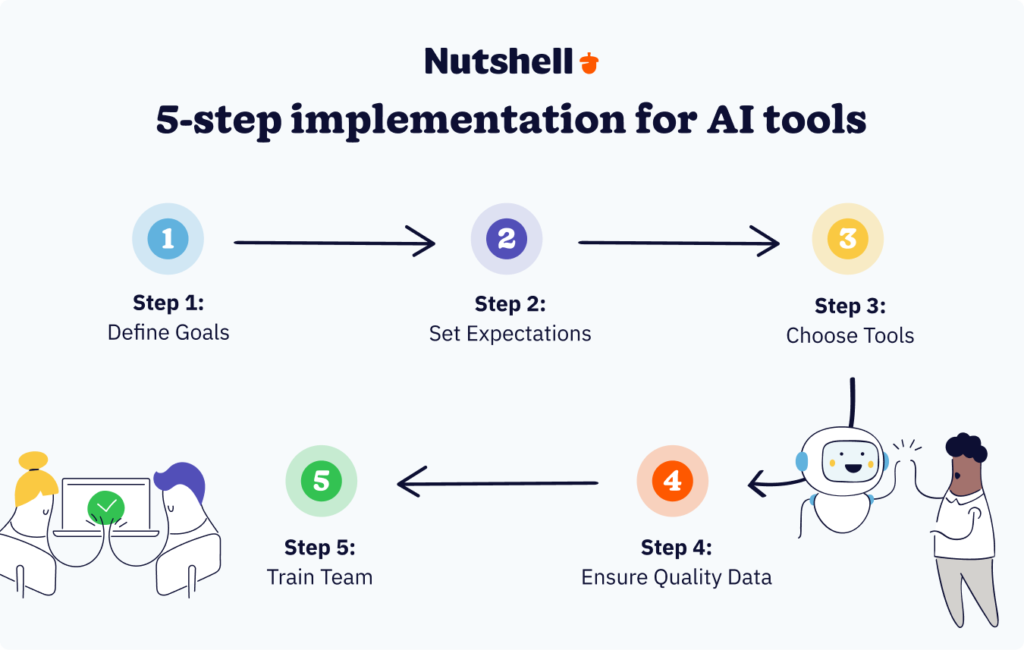
Five-step process diagram for implementing artificial intelligence in sales operations from goal definition through team training

Define your goals with specificity

Before implementing AI sales tools, create a solid strategy grounded in specific outcomes. Vague goals like “improve efficiency” won’t guide good decisions. Instead, identify concrete problems AI should solve.

Ask yourself what’s slowing your team down right now: 

  • Is it manual data entry consuming hours each week? 
  • Lead qualification eating up selling time? 
  • Inaccurate forecasts making planning difficult? 

Each pain point suggests different AI applications.

Define success metrics upfront. If you’re targeting data entry reduction, measure current hours spent and set a reduction target. If you’re improving forecast accuracy, baseline your current variance and define acceptable improvement. Having concrete goals gives you something to measure against, enabling course corrections and demonstrating ROI.

Set realistic expectations about capabilities and timelines

AI is powerful, but it’s not magic. Setting realistic expectations upfront prevents disappointment and helps you plan appropriately.

Research AI capabilities and limitations thoroughly before committing:

  • Generative AI can draft emails and summarize conversations, but it sometimes produces inaccurate information requiring human review. 
  • Predictive AI improves forecasting accuracy, but it needs quality historical data to learn from.
  • Automation reduces manual work, but it requires time to set up and refine.

Timeline expectations matter, too. Implementing AI tools typically takes longer than vendors suggest. Plan for two to four months from selection to meaningful results, not two to four weeks. Your team needs time to learn, your data needs cleanup, and your workflows need adjustment. Companies that rush implementation often face adoption resistance and poor results.

The payoff is worth the patience. Teams that invest adequate time in proper implementation see sustained benefits. Those that rush often abandon tools before realizing value, wasting both money and team morale.

Choose the right AI sales tools for your specific needs

Tool selection is crucial. The most sophisticated AI won’t help if it doesn’t fit your workflow or if your team won’t use it.

1. Match tools to your defined goals

If your main challenge is lead qualification, prioritize AI with strong predictive lead scoring. If it’s forecast accuracy, look for platforms with proven analytics capabilities. If it’s manual data entry, focus on tools with automated activity capture.

2. Consider integration carefully

AI that requires constant data export and import creates friction. Look for tools that connect seamlessly with your existing CRM and other core platforms. Nutshell’s AI capabilities integrate directly into the workflow reps already use, eliminating the need to jump between systems.

3. Evaluate vendor support and training resources

The technology matters, but so does the implementation help you’ll receive. Companies offering comprehensive onboarding, training materials, and responsive support dramatically improve your odds of success.

4. Budget realistically

AI for sales costs vary widely, from $50 per user per month for AI-powered CRMs to hundreds of thousands annually for enterprise solutions. Many modern CRMs like Nutshell include AI features in their standard plans, making advanced capabilities accessible without separate subscriptions or complex implementations.

5. Don’t get distracted by feature lists

The tool with the most capabilities isn’t always the best choice. The right tool solves your specific problems, fits your budget, and works the way your team actually sells.

Ensure quality data as your foundation

To get quality output from AI, you need quality data. Garbage in, garbage out isn’t just a saying—it’s the reality of AI implementation.

Start by auditing your current data. Is customer information complete and accurate? Are sales activities being logged consistently? Do you have enough historical data for AI to learn from? Most AI tools need at least six to twelve months of clean data to generate reliable insights.

Use a top-tier CRM with built-in data quality features. Nutshell helps keep data organized and accurate through automated activity capture, duplicate detection, and required field enforcement. These features prevent data quality issues before they start rather than requiring cleanup later.

Follow data management best practices consistently. Establish clear standards for how information gets entered. Create regular data hygiene routines to catch and fix issues. Make data quality everyone’s responsibility, not just something that gets attention when reports break.

Consider providing AI tools with your organization’s specific data to make outputs more relevant. Many AI platforms can be trained on your historical wins, losses, and customer interactions to deliver recommendations tailored to your business rather than generic best practices.

Clean, complete data isn’t just about making AI work—it’s about making it work well. The difference between mediocre AI results and transformational AI results often comes down to data quality.

Invest time in training and change management

Technology doesn’t deliver value—people using technology deliver value. To get real results from AI tools, your team must fully understand why and how to use them.

Training needs to go beyond feature demonstrations. Help your team understand the problems AI solves, the time it saves them, and how it makes their jobs easier. When people see personal benefit, adoption follows naturally.

Address concerns directly. Some team members will worry that AI threatens their jobs. Others will be skeptical about accuracy. Still others will resist changing comfortable habits.

Create space for these concerns and address them honestly. Share examples of AI augmenting human capabilities rather than replacing them. Show how AI handles busywork so reps can focus on relationship-building and strategy.

Celebrate wins publicly. When a rep closes a deal faster because of AI-generated insights, share that story. When forecast accuracy improves, acknowledge it. When someone discovers a clever AI use case, highlight it for the team. Success stories build momentum and encourage broader adoption.

Change takes time. Don’t expect overnight transformation. Plan for three to six months before AI becomes truly embedded in your team’s daily routine. The investment in proper training and change management pays dividends in sustained adoption and better results.

The importance of AI-enhanced CRM in modern sales strategy

A strong sales team thrives with an effective CRM system. The right CRM helps streamline processes and boost productivity for your sales team.

An increasingly vital feature of modern CRMs is their AI capabilities. AI-driven CRMs improve efficiency by automating repetitive tasks and delivering actionable insights through advanced analytics.

By embracing AI in CRM systems, sales teams can dedicate more time to strategy and nurturing customer relationships, while AI integration simplifies their workflows.

Nutshell Business empowers sales teams to leverage artificial intelligence effectively. With advanced capabilities such as AI-powered timeline summarization and Zoom meeting transcriptions, Nutshell Business enhances productivity and streamlines workflows.

The AI landscape is evolving rapidly. Understanding where the technology is heading helps you make smarter adoption decisions today. Here are five trends defining AI in sales for 2026 and beyond.

Agentic AI moves from concept to reality

The biggest shift in 2026 is the rise of agentic AI—systems that don’t just respond to prompts but autonomously pursue goals. Unlike traditional AI tools that wait for instructions, agentic systems can plan multi-step workflows, execute tasks across multiple tools, and adapt based on results.

Think of the difference this way. Traditional AI might draft an email when you ask. Agentic AI identifies which prospects need follow-up, drafts personalized messages for each, schedules optimal send times, monitors responses, and adjusts future outreach based on what works. It handles the entire workflow, not just individual tasks.

According to McKinsey’s 2025 research, 62% of organizations are now experimenting with AI agents. The technology has matured enough for practical deployment, and early adopters are seeing substantial productivity gains. For sales teams, this means moving from AI as an assistant to AI as an autonomous team member that handles routine workflows while humans focus on strategy and relationship-building.

Workflow redesign becomes more important than the AI itself

Here’s what separates AI success stories from expensive disappointments: it’s not the technology, it’s the workflow redesign.

Research shows that 50% of high-performing AI adopters fundamentally redesigned their workflows rather than simply automating existing processes. The difference is crucial. Automating a broken process just gives you faster dysfunction. Redesigning the workflow around AI capabilities unlocks transformational results.

For sales teams, this means rethinking how work gets done. Instead of asking “How can AI help us do our current tasks faster?” the better question is “If we rebuilt this process from scratch with AI capabilities, what would it look like?”

The companies seeing 30% to 40% improvement in key metrics aren’t the ones with the most sophisticated AI. They’re the ones who took the time to reimagine their processes before implementing technology.

Hyperautomation combines AI with RPA and orchestration

The next evolution isn’t just AI—it’s the convergence of AI with Robotic Process Automation (RPA) and workflow orchestration into what’s being called “hyperautomation.”

RPA handles rule-based, repetitive tasks like data entry and lead routing. AI handles judgment-based activities like qualification and personalization. Orchestration platforms connect everything into seamless workflows. Together, they create end-to-end automation that wasn’t possible with any single technology.

In practical terms, this means your CRM does time-consuming admin tasks without manual intervention: 

  • Logs updates automatically after sales calls
  • Generates follow-up tasks based on conversation analysis
  • Routes leads to the right rep based on fit and availability
  • Assembles personalized content dynamically for each prospect

For sales teams already stretched thin, hyperautomation does more than save time. It eliminates entire categories of administrative work, freeing reps to focus on the human elements of selling that actually close deals.

Predictive AI shifts from reactive to proactive selling

Predictive AI has moved beyond simple lead scoring. Modern systems analyze behavioral signals, intent data, ideal customer profile fit, and buying journey patterns to identify high-probability opportunities before competitors even know they exist.

The shift is from asking “Which leads should we prioritize?” to “Which prospects are showing buying signals right now, and what’s the optimal next action?” This real-time intelligence enables proactive outreach at exactly the right moment rather than reactive follow-up after opportunities cool down.

Companies using advanced predictive AI report improvements in lead qualification time reaching 40%, with pipeline efficiency gains ranging from 15% to 25%. The technology helps sales teams work smarter, not just faster—focusing energy on prospects most likely to convert.

Voice and conversational interfaces make AI more accessible

The way sales teams interact with AI is changing. Voice-driven CRM commands and conversational interfaces are becoming mainstream, reducing the friction that often hampers technology adoption.

Instead of navigating complex dashboards or typing queries, reps can simply ask “Show me my top accounts this quarter” or “What’s the status of the Acme deal?” and get instant answers. This natural interaction pattern dramatically improves adoption rates, particularly among field sales teams who need information quickly while on the move.

These trends aren’t predictions anymore—they’re already reshaping how forward-thinking sales teams operate. The question isn’t whether these changes will affect your industry. It’s whether you’ll lead the transition or scramble to catch up later.

Supercharge your CRM with the Power of AI


Nutshell’s Business plan gives your team the ability to generate AI-powered timeline and Zoom call summaries — plus do everything else you can with our Nutshell Pro plan.

EXPLORE BUSINESS

AI and the future: Could AI replace salespeople?

AI is becoming an increasingly valuable tool for sales teams. But can AI replace sales people? In short, the answer is no. AI can’t replace the human touch that is essential in sales. However, it is essential for salespeople to embrace AI tools for sales and marketing efforts, as it can help salespeople with many aspects of their roles. From sales prospecting to lead generation, personalization, predictive analytics, and chatbots, AI-powered tools are providing sales teams with data and insights that help them to be more effective and efficient. If salespeople don’t adopt AI, they risk falling behind.

With the right approach to using AI tools for sales, teams stay ahead of the competition, achieve their goals more quickly, and spend more time on the most impactful tasks.

Frequently asked questions about using AI in sales

  • 1. How much does AI for sales cost?

    AI for sales costs vary widely, from $50 per user monthly for AI-powered CRMs to hundreds of thousands annually for enterprise solutions. Many modern CRMs like Nutshell include AI features in their standard plans, making advanced capabilities accessible without separate tool costs. The key is choosing an integrated solution that delivers value without requiring multiple subscriptions or complex implementations.

  • 2. Can small businesses benefit from using AI in sales?

    Absolutely. Small businesses often see the biggest impact from AI because it levels the playing field with larger competitors. AI helps small teams work smarter by automating lead qualification, personalizing outreach at scale, and providing data-driven insights—all without adding headcount. With 75% of small businesses already investing in AI, it’s become essential for staying competitive and maximizing limited resources.

  • 3. What’s the difference between AI tools and an AI-powered CRM?

    AI tools are standalone solutions for specific tasks like email writing or call transcription, while an AI-powered CRM integrates AI capabilities directly into your sales workflow. An AI-powered CRM eliminates the need to juggle multiple platforms, automatically syncs data, and provides unified insights across your entire sales process. This integration saves time, reduces costs, and ensures your AI works seamlessly with your existing processes.

  • 4. How do I get started with AI in my sales process?

    Start by identifying your biggest time drains—like manual data entry, lead qualification, or email follow-ups. Choose an AI-powered CRM that addresses these pain points with built-in features rather than requiring separate tools. Begin with one or two AI capabilities, train your team on best practices, and gradually expand usage as you see results. The key is starting small, measuring impact, and scaling what works.

  • 5. What AI features should I look for in a CRM?

    Look for predictive lead scoring to prioritize high-value prospects, automated activity capture to eliminate manual data entry, and intelligent email assistance for faster responses. Timeline summarization helps you quickly understand customer history, while sales forecasting provides accurate pipeline predictions. The best AI-powered CRMs integrate these features seamlessly rather than requiring separate tools or complex setup.

Want to start leveraging AI and automation?

Looking to improve your data management and integrate automation and AI into your sales process? Nutshell can help. Our CRM makes it easy to keep your data organized and accurate and gather insights from your data with insightful reporting. With Nutshell, you can also easily automate elements of your sales process, collaborate with your team, use AI to gather insights into your customer relationships, and more CRM features.

Through our partnership with WebFX, we also offer access to advanced revenue marketing technology as well as implementation and consulting services for sales and marketing technology.

WebFX’s revenue marketing platform, RevenueCloudFX, unifies your data and uses AI to provide insights to help you optimize campaigns, personalize content, and automate processes, boosting leads, sales, and revenue. Plus, WebFX’s implementation and consulting services help you build your ideal tech stack and make the most of your technology.

To learn more about Nutshell or WebFX’s technology and services, click the buttons below.

Discover Nutshell

Explore tech implementation and consulting


BACK TO TOP

Join 30,000+ other sales and marketing professionals. Subscribe to our Sell to Win newsletter!